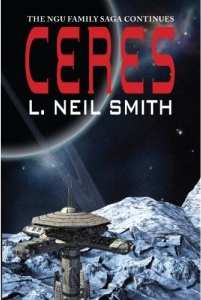
Ceres, a finalist for the 2011 Prometheus Award for best libertarian novel, is the latest opus from noted libertarian author L. Neil Smith, best known for The Probability Broach. As you would expect from Mr. Smith, Ceres is a treasure trove for the liberty lover, a work that could only come from an uncompromising libertarian. Nearly every page has some sound libertarian principle or perhaps a new twist on libertarian ideas that the reader may not have considered before. For instance, we know that government is coercion, an institution organized around this principle, but have we considered the role of agriculture in the development of the State? Was it perhaps our settling down into permanent communities that allowed for the contraction of that particular disease? Right or wrong, it's food for thought and worth considering. Ceres is filled with such things.
The story takes place in the 22nd century and follows the lives of characters connected in some way to the terraforming of Ceres, the planetoid – now called a dwarf planet — and largest object in the main asteroid belt. Most of the protagonists belong to the Ngu family, and those that don't are close friends. Llyra Ayn Ngu is a figure skater born on Pallas, an object in the asteroid belt even smaller than Ceres. She goes to Ceres to acclimate her body to its greater gravity, and from there moves to the Moon, and thence to Mars and finally to Earth, where she dreams of ice skating success.
The different sections of the book are named after the gravity of each body, whether it's one tenth gee, one sixth, one third or one gee. Given this, we might call Llyra the main character, although her brother Wilson gets just as much attention. Nevertheless, Llyra's goal and struggle to achieve it are the only constants in the novel, present from the opening chapter to the end. The rest concerns the various interests of the Ngu family and friends, often when in conflict with the environmentalists who seek to stop human expansion into space and the sullying of the environment as they see it.
It is beyond dispute that L. Neil Smith is a dedicated libertarian. He has spent many hours of his life pouring himself into prose, seeking to spread the libertarian ethic and philosophy for the betterment of mankind. However, just as, in a debate, a libertarian stands a better chance of convincing if the other party genuinely likes him, so too does a book stand a better chance of convincing in proportion to how much it charms the reader. One might make a few suggestions in the interest of getting the most out of Ceres.
[continue reading…]
Help Promote Prometheus Unbound by Sharing this Post
Locus Magazine is starting to take its first steps into the digital age.
For those not in the know, Locus Magazine is, as its subtitle suggests, The Magazine of the Science Fiction and Fantasy Field. It is the pre-eminent magazine covering the genre publishing industry, prose fiction, and conventions, featuring reviews, news, interviews, publishing data, and more.
With the January 2011 issue, which will focus on SF in the digital age, the magazine will publish its first digital edition. The digital editions will be available in pdf format at first. Epub and Kindle editions might come in the future. This is good news to be sure.
[continue reading…]
Help Promote Prometheus Unbound by Sharing this Post
Melancholy Elephants, a Hugo Award winner from 1983, is the kind of story you get when a talented craftsmen, after some genuine contemplation on a topic, has come up with a unique perspective on an issue, discovered something worth thinking about. For the libertarian, it has the added attraction of advocating freedom of artistic expression, as well as a frank depiction of government corruption. Though Spider Robinson's short work fizzles at the end, it's engaging and thought-provoking and ultimately worth your time.
Despite the mildly disappointing ending, I cannot find fault with the beginning. Even the title is exactly what a title should be: odd enough to be intriguing while encapsulating what the story is about, but this becomes obvious only afterwards. It gives away nothing of the tale at the outset.
The short story format affords an author little time to grab his reader's attention; Spider Robinson does it in the first paragraph. The main character, Dorothy Martin, has such a bizarre reaction to a situation she is subjected to that any impulse to put the story down evaporates, rather like what a startle does to the impulse to yawn.
[continue reading…]
Help Promote Prometheus Unbound by Sharing this Post
A few notable things I ran across recently:
- Will Thomas of The Atlas Society (formerly known as The Objectivist Center) argues that transhumanism is compatible with Objectivism.
- Kylie Sturgess, in her Curiouser and Curiouser column for the Committee for Skeptical Inquiry, interviewed Scott Sigler. I hadn't heard of him before, but apparently he's known as a podcaster and now also as an author of techno-thrillers.
Sigler describes skeptics as people
who were spreading the other side of the information instead of misinformation. They are out actively encouraging people to think for themselves, and what's been interesting is that they're not necessarily telling people “this is bunk.” They are encouraging people to think critically about things and learn how to address things when you run into them.
He goes on to mention how, among other things, evolution is being challenged in America. But there's a flipside to long-accepted, fairly well-established science being attacked in knee-jerk fashion by those faith-based types leery of science in general and of science that challenges their religious beliefs in particular. Sometimes science can become corrupted in politically-charged fields, and scientists lose their objectivity. I'm reminded of an old post I wrote about scientific skepticism in relation to global warming alarmism. I riffed off of Clarke's First Law of Prediction and Asimov's Corollary.
But to get back to Scott Sigler, has anyone read any of his work? If so, what do you think? Do you recommend it?
[continue reading…]
Help Promote Prometheus Unbound by Sharing this Post
Via Cory Doctorow at Boing Boing comes word of this funny piece of flash fiction, a science fiction story disguised as a review of a set of $6,800.00 audio cables, themselves a free market wealth redistribution mechanism in disguise, designed to seduce gullible audiophiles out of their money.
We live underground. We speak with our hands. We wear the earplugs all our lives.
PLEASE! You must listen! We cannot maintain the link for long… I will type as fast as I can.
DO NOT USE THE CABLES!
We were fools, fools to develop such a thing! Sound was never meant to be this clear, this pure, this… accurate. For a few short days, we marveled. Then the… whispers… began.
Were they Aramaic? Hyperborean? Some even more ancient tongue, first spoken by elder races under the red light of dying suns far from here? We do not know, but somehow, slowly… we began to UNDERSTAND.
[continue reading…]
Help Promote Prometheus Unbound by Sharing this Post
[Warning: Contains some spoilers, mainly in the 6th and 7th paragraphs.]
Every so often a book comes along that truly makes you appreciate writing as a subject; one that truly captures the imagery that we see and feel in our lives when we so often lack the time for reflection.
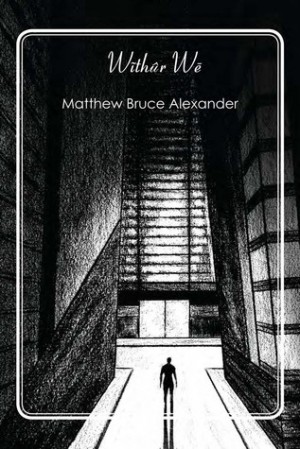
Wĭthûr Wē is such a book. Yet, such a recommendation doesn't quite do it justice because its beautiful imagery is only a backdrop for a rich libertarian narrative and struggle of ideas.
Wĭthûr Wē is set several centuries in the future. We never learn the exact year but late in the book we discover that it must be the 28th century. Humans have colonized a small portion of the galaxy — perhaps a thousand light years across — but have yet to discover any alien civilizations. Only the three million year old Ruins on the planet Kaldis provide any proof that non-human intelligence exists, or at least existed once, in the universe.
Alistair Ashley 3nn, the main character of the tale and mouthpiece of Rothbardian philosophy, has just returned from his tour of duty on Kaldis, a human colony at war over their form of government. His experiences have obviously marked him, because those who knew him before he left remark on how different he now is, both physically and emotionally. Alistair has prepared well for his return to Aldra, his home planet, and its tightly regulated — and therefore wÄthà»ring — economy. Through a clever, and very sci-fi, technique, he smuggles instructions for making black market medicine and sells them to black market merchants. He demands gold, not the easily inflatable Aldran Credit which is nothing more than a bit of electronic information stored on a magnetic strip.
Alistair, who has disavowed the 3nn which the government tacked onto his name, was taught the principles of libertarianism by his grandfather who died while he was “off” on Kaldis. He returns angry at the atrocities he has seen and his anger only grows when he sees how much further towards serfdom his home planet has travelled in the four cycles (years) since he has been off. When his father's home is stolen by the government in an Aldran version of eminent domain, he uses the money from his medicine sale to begin his own private rebellion. He begins by burgling the house of the politician who stole his father's home, bitterly noting as he leaves that most people would consider Alistair the thief, and not the politician.
[continue reading…]
Help Promote Prometheus Unbound by Sharing this Post
That was to be the subtitle for my chapter in Open Court's recent addition to their Popular Culture and Philosophy series, Transformers and Philosophy: More Than Meets the Mind. Alas, no subtitles made it into the book.
I have official permission to provide a pdf copy of my chapter, “Freedom Is the Right of All Sentient Beings. Technically, I don't think I really need legal permission; I don't recall signing over to Open Court the copyright that federal law automatically vests in me as the author. Anyway, download it from that link and enjoy!
The chapter title comes from a quote by Optimus Prime in the first of the recent live action movies (see my review). The chapter itself is kind of a condensed and lite version of the Aristotelian-liberal theory of virtue ethics and natural rights explained in more detail in my dissertation, applied to the transformers and to artificial intelligences more generally.
~*~
Cross-posted at Is-Ought GAP.
Help Promote Prometheus Unbound by Sharing this Post


