- In July, Amazon announced that Kindle book sales had surpassed hardback book sales. Analysts pooh-poohed this milestone as paperback sales are far greater than hardback sales. But now Kindle book sales have overtaken paperback sales as well. Amazon is now selling more digital or ebooks in its bookstore now than physical print books. We've reached a turning point in the way people read books.
There is still a ways to go, however, for ereader owners are still buying print books and ereader ownership is still not mainstream. While the adoption of ereaders is spreading, even at an accelerating pace, a recent survey of book shoppers shows that only 21% own one. I don't own one yet, though I hope to buy an Android tablet in the next year or so.
I'm not sure print books will ever go the way of the dodo. Print books will increasingly have collector value. Some people may still prefer reading them, if only out of nostalgia for a bygone era. There are ways to add value to a print book as well: high-quality production, handwritten signatures, personal notes, and so on.
Prose
Help Promote Prometheus Unbound by Sharing this Post

BOOK AND ARTICLE REVIEW | The Oft-Ignored Mr. Turton in E.M. Forster’s A Passage to India
in “Literary” Fiction, Film, Novels, Reviews
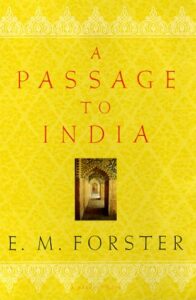
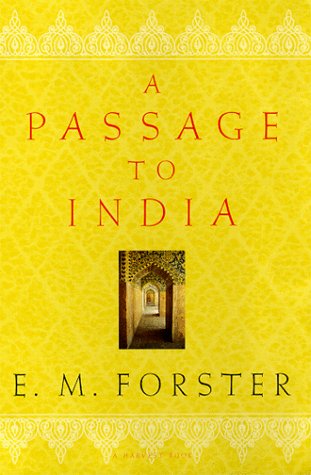
A Passage to India, by E.M. Forster [trade paperback]; also made into an award-winning film.
Perhaps the most important task of all would be to undertake studies in contemporary alternatives to Orientalism, to ask how one can study other cultures and peoples from a libertarian, or a nonrepressive and nonmanipulative, perspective.
When I asked Dr. Plauché what I should review for my first contribution to Prometheus Unbound, he suggested that I elaborate on my recent Libertarian Papers article: “The Oft-Ignored Mr. Turton: The Role of District Collector in A Passage to India.” Would I, he asked, be willing to present a trimmed-down version of my argument about the role of district collectors in colonial India, a role both clarified and complicated by E.M. Forster's portrayal of Mr. Turton, the want-to-please-all character and the district collector in Forster's most famous novel, A Passage to India. I agreed. And happily.
 For those who haven't read the novel, here, briefly, is a spoiler-free rundown of the plot. A young and not particularly attractive British lady, Adela Quested, travels to India with Mrs. Moore, whose son, Ronny, intends to marry Adela. Not long into the trip, Mrs. Moore meets Dr. Aziz, a Muslim physician, in a mosque, and instantly the two hit it off. Mr. Turton hosts a bridge party — a party meant to bridge relations between East and West — for Adela and Mrs. Moore. At the party, Adela meets Mr. Fielding, the local schoolmaster and a stock character of the Good British Liberal. Fielding invites Adela and Mrs. Moore to tea with him and Professor Godbole, a Brahman Hindu. Dr. Aziz joins the tea party and there offers to show Adela and Mrs. Moore the famous Marabar Caves.
When Aziz and the women later set out to the cavea — Fielding and Godbole are supposed to join, but they just miss the train — something goes terribly wrong. Adela offends Aziz, who ducks into a cave only to discover that Adela has gone missing. Aziz eventually sees Adela speaking to Fielding and another Englishwoman, both of whom have driven up together, but by the time he reaches Fielding the two women have left. Aziz heads back to Chandrapore (the fictional city where the novel is set) with Fielding, but when he arrives he is arrested for sexually assaulting Adela. A trial ensues, and the novel becomes increasingly saturated with Brahman Hindu themes. (Forster is not the only Western writer to be intrigued by Brahman Hinduism. Ralph Waldo Emerson and William Blake, among many others, shared this fascination.) The arrest and trial call attention to the double-standards and arbitrariness of the British legal system in India.
Rule of law was the ideological currency of the British Raj, and Forster attempts to undercut this ideology using Brahman Hindu scenes and signifiers. Rule of law seeks to eliminate double-standards and arbitrariness, but it does the opposite in Chandrapore. Some jurisprudents think of rule of law as a fiction. John Hasnas calls rule of law a myth. Whatever its designation, rule of law is not an absolute reality outside discourse. Like everything, its meaning is constructed through language and cultural understanding. Rule of law is a phrase that validates increased governmental control over phenomena that government and its agents describe as needing control. When politicians and other officials lobby for consolidation or centralization of power, they often do so by invoking rule of law. Rule of law means nothing if not compulsion and coercion. It is merely an attractive packaging of those terms.
Help Promote Prometheus Unbound by Sharing this Post

Amusing bibliophile-parody music video — I'm Reading a Book — by Julian Smith:
Help Promote Prometheus Unbound by Sharing this Post

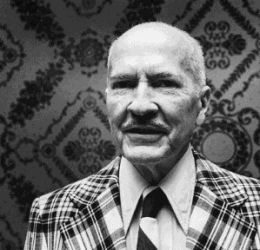
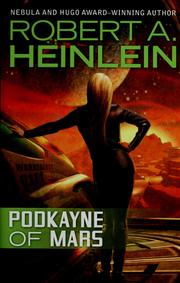 When Robert Heinlein told a tale, it was with a compelling and engrossing voice. He created personalities with interest and depth and fashioned dramatic interactions to keep us involved. However much or little happens to his characters, the experience for us readers is enhanced because we become invested in the people who inhabit his stories. Even a book like Podkayne of Mars, which one might quibble is a touch underplotted, is a satisfying read because of the investment in the people.
Podkayne Fries, a girl on the verge of womanhood with dreams of becoming an interplanetary ship captain, is the principle narrator and protagonist of the story. She and her younger brother Clark get an opportunity to accompany their uncle on a voyage to Venus and Earth. Her uncle, however, is an ambassador and there are those who would interfere with his mission, disdaining no despicable act in their attempts. That is about all there is to the story structure. There are a few plot points thrown in – such as the mysterious object Clark smuggles on board, or the solar storm that catches them between planets – and the ending is harrowing, but it becomes clear early on that the novel's strongest points lie elsewhere.
Help Promote Prometheus Unbound by Sharing this Post

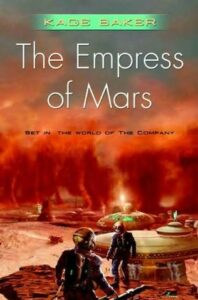
 The Empress of Mars
By Kage Baker
Trade paperback, 304 pages
Tor (2009), $10.87
The Empress of Mars was written by the late Kage Baker (June 10, 1952 — January 31, 2010; 1st name pronounced like ‘cage'). It started out as a novella (Asimov's Science Fiction Magazine July 2003), which won the 2004 Theodore Sturgeon Award and was nominated for a Hugo Award and a Nebula Award, but was later expanded into the full-length novel published in 2009 that I review here.
The Empress of Mars is not Martian royalty. This is not Barsoom, the Mars of Edgar Rice Burroughs. You won't find a John Carter-type hero fighting native Martians and rescuing princesses within these pages, though Baker does pay homage to Burroughs' Mars tales. Tars Tarkas makes an appearance as the Martian Santa Claus, for example.
No, The Empress of Mars is a restaurant and bar owned by one Mary Griffith, an early settler of Mars and former biological scientist. A tough, motherly figure, Mary Griffith embodies the rugged individualism and pioneer spirit that pervades Baker's The Empress of Mars. Baker's tale is more scientifically literate than Burroughs', and qualifies (mostly at least, see below) as hard science fiction, leavened with superior writing and humor. It is set some unspecified time after the year 2186 — marking a past event, the year the Kutuzov expedition discovered Olympus Mons is not an extinct shield volcano, it was the only date I recall seeing in the novel.
The story revolves around Mary, her three daughters, and a host of other quirky characters, some of whom she takes under her wing, others she befriends or does business with, as they deal with at first neglect by and then interference from the bureaucrats of the British Arean Company (BAC).
Help Promote Prometheus Unbound by Sharing this Post

Innovative Funding Experiment(s) at Clarkesworld Magazine
in Fantasy Fiction, IP, Magazines, News, Science Fiction, Short Fiction
Clarkesworld Magazine is an online science fiction and fantasy magazine that features at least two original short stories per month from new and established authors as well as artwork, podcasts, and non-fiction articles. Founded in October 2006 by Neil Clarke, its online content is totally free. The magazine has been experimenting with innovative methods of funding. No paywalls or DRM or desperate IP aggression here.
While its content is freely available online, Clarkesworld sells print versions of its fiction. An annual anthology series, Realms, is available in trade paperback, hardcover, and ebook formats. Additionally, several months after online publication, each month's fiction is collected in chapbook form; the value-add here is that the chapbooks are limited print run (100), numbered editions that are signed by the authors. If you happen to have a tablet pc or ereader, you can also purchase ebook editions of each monthly online issue in epub or mobi/kindle format.
Help Promote Prometheus Unbound by Sharing this Post

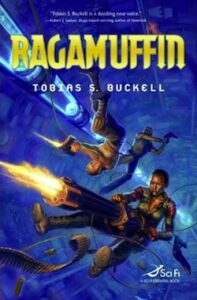
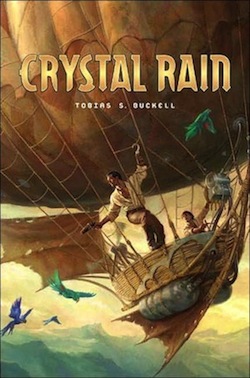
Steampunk is currently all the rage, but this book was published before steam engines and airships and whatnot became recently fashionable. And besides, Crystal Rain (Tor, 2007) is not your ordinary steampunk. It has a healthy dose of post-apocalyptic science fiction as well, but here too Crystal Rain breaks the mold. On the one hand, the setting includes sailboats and airships, gaslights, firearms, and, mostly in Capitol City, steam-powered trains, cars, and even a ship, and trolly-like electric cars. I don't recall any conspicuous leather, aviation goggles, brass, or clockwork though. On the other hand, we quickly find out that this story takes place centuries after some cataclysmic disaster. There are near-mythical stories of the “old fathers,” and Preservationists seek to restore lost technologies. A barren area inland called Hope's Loss causes people who travel through it to sicken and die. To add another twist, we quickly discover the story takes place not on Earth, but some distant planet, by the casual description of two moons in the sky and tales of the old fathers traveling to the land of Nanagada via “worm's holes” and warming the planet with mirrors in the sky that have since crashed and burned. Turns out Nanagada is a lost colony planet. Caribbean-born author Tobias Buckell adds spice to the mix by populating the setting of his debut novel with a collection of mostly non-white races, dominated by Caribbean culture and dialect.
Actually, the first hints that you're not reading the typical steampunk or post-apocalyptic novel come in the prologue when a mysterious black man with dreadlocks, dressed in top hat and trenchcoat, falls out of the sky in a “steaming metal boulder,” speaks gibberish to the natives for a minute, then after manipulating his throat suddenly speaks their language. He appears tired and thin, weak, so the natives take him back to their village — though he has strength left in him to kill a jaguar effortlessly with his bare hands on the way. After a week of pigging out, he's all buffed out. All he tells them is that he's looking for an old friend. This mysterious, superhuman figure we later find out to be Pepper, who features in several subsequent novels and short stories by Buckell. The author handles him well. Pepper has his limits, which are tested in the novel, and while he often appears to be a “looking out for #1,” cold-blooded mercenary-type, Buckell manages to give him a depth that defies expectations.
But the main protagonist of Crystal Rain is the man Pepper is looking for: John deBrun. John is a sailor, fisherman, and painter, with a hook in place of the left hand that he lost to frostbite on an ill-fated excursion to the icy north. He remembers nothing of his past from before he washed ashore 27 years prior in the town of Brungstun near the Wicked High Mountains that separate the Nanagadan Peninsula from the rest of the continent. But he has an uncanny ability to navigate, as if he has a GPS in his head. He has settled down there, married, and has a 13-year old son. Oh, and he doesn't seem to have aged much in those 27 years.
Little do most know at the start, but the Azteca, who live on the other side of the Wicked Highs, are being driven by their bloodthirsty gods, the Teotl, to cross the mountains and invade Nanagada. Another main viewpoint character, Oaxyctl (O-ash-k-tul), who is actually an Aztecan double agent spying for the Nanagadans, has the bad luck to be accosted by one if his gods and tasked with tracking down John deBrun and delivering him to it or else Oaxyctl's life will be forfeit. The Teotl needs John alive because it believes he alone possesses secret codes to unlock the Ma Wi Jung. Whatever that is. (Heh. Is John “The Chosen One”?) Oaxyctl is placed in an impossible position: mortally afraid of his gods, still fundamentally an Aztecan despite working for the Nanagadans, he later comes to like John, whom he rescues from an Aztecan war party's sacrificial altar after John had been separated from his family and captured. Buckell keeps us wondering when, or if, Oaxyctl will betray John's trust.
Help Promote Prometheus Unbound by Sharing this Post


