Prose

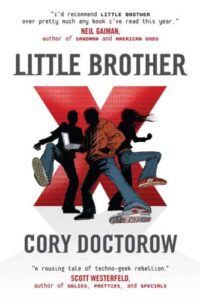
BOOK REVIEW | Little Brother by Cory Doctorow Thumbnail

Cory Doctorow's Little Brother is a tale about tech-savvy teenagers as they rebel against a Department of Homeland Security crackdown following a terrorist attack on San Fransisco. A piece of YA fiction that even adults can enjoy — it's YA largely because of its teenage protagonists and its educational aim at young people — Little Brother is the 2009 Prometheus Award winner for best libertarian novel. Little Brother also won the John W. Campbell Memorial Award and was a finalist for the Hugo Award.

Little Brother is set entirely in San Fransisco, California, in the very near future. Much of the technology in the story is already available, and what is not can easily be conceived as being on the horizon. The story is told entirely in the first person, from the point of view of the main character, Marcus Yallow. Marcus at first goes by the handle w1n5t0n (Winston in leetspeak, a homage to George Orwell's 1984, as is the title of the book) but later switches to M1k3y (which could be a reference to the computer Mike in Robert Heinlein's The Moon is a Harsh Mistress).

As the story opens, we are introduced to Marcus and three of his friends — Jolu (Jose Luis), Van (Vanessa), and best friend, Darryl — who ditch school to play an ARG (Alternate Reality Game) called Harajuku Fun Madness in and around the city. They happen to have the misfortune of being in the wrong part of town when terrorists blow up the Bay Bridge. In the chaos and confusion that follows, they get picked up by the Department of Homeland Security and then subjected to several days of interrogation and psychological torture in a “Gitmo by the Bay” before being released (with the exception of Darryl) with threats to keep quiet about their experience…or else. But once set free, Marcus and his friends are disturbed to see their city being turned into a police state.

Marcus resolves to fight back against the DHS, to restore civil rights and liberties and to free Darryl. He soon becomes the unofficial leader of a growing, decentralized movement of rebellious teenagers. But his covert struggle starts to put a strain on his relationships with his family and friends.

[continue reading…]

Help Promote Prometheus Unbound by Sharing this Post

With great solemnity, “Defense” Secretary Robert Gates imparted on West Point cadets this Friday a hard-earned pearl of newly discovered wisdom:

In my opinion, any future defense secretary who advises the president to again send a big American land army into Asia or into the Middle East or Africa should ‘have his head examined,' as General MacArthur so delicately put it,” Mr. Gates told an assembly of Army cadets here.

In other words, “Never get involved in a land war in Asia.”

Sounds like good advi… Wait,what? Not everyone knows this already? Inconceivable!

Any culturally literate person has seen The Princess Bride at least once in the last 24 years1 and certainly knows about the most famous classic blunder:

[continue reading…]


  1. The novel by William Goldman was published over a decade earlier in 1973. But I imagine this bit of wisdom goes back much further. 

Help Promote Prometheus Unbound by Sharing this Post

Lots of news to catch up on with this post.

  1. Over a decade ago, a Russian paleontologist wrote an alternative take on the War of the Ring from J.R.R. Tolkien's The Lord of the Rings. Recently translated into English, Kirill Yeskov's The Last Ringbearer tells the tale from the point of view of Mordor, the bad guys in Tolkien's epic.

    History is usually written by the victors, but now the truth of the War of the Ring has finally come out. Gandalf is portrayed as a warmonger bent on destroying a bastion of civilization dedicated to reason, science, technology, and industrialization because science “destroys the harmony of the world and dries up the souls of men!” The elves are bent on world domination and Aragorn is a Machiavellian schemer whose strings are pulled by his wife, Arwen.

    If you're intrigued, you can learn more about The Last Ringbearer from the Salon.com article “Middle-Earth according to Mordor” and, also on Salon.com, the author's own account of why he wrote the novel. You can download The Last Ringbearer for free and give it a read. Here's to hoping Christopher Tolkien doesn't aggress against Yeskov by launching a copyright or trademark infringement lawsuit.
  2. Finally, the print magazine, Analog Science Fiction and Fact, is entering the digital age and switching from snail mail to an electronic submissions system.
  3. In my previous news roundup, I posted the trailer of the upcoming movie adaptation of Ayn Rand's Atlas Shrugged as well as some reports from people who had seen an advance preview and an interview with the producer. Here's more footage, the scene in which Henry Rearden returns home and gives his wife a bracelet made from the first pouring of Rearden Metal:
    [continue reading…]

Help Promote Prometheus Unbound by Sharing this Post

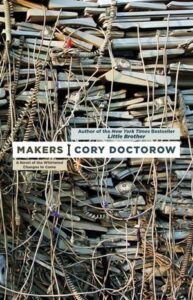
BOOK REVIEW | Makers by Cory Doctorow Thumbnail

I didn't like Makers. I wanted to like it. Cory Doctorow, the author, is a cool geek and something of an ally in the struggle against intellectual property, i.e., government grants of monopoly privilege. But overall I just did not enjoy the book for a number of reasons.

To be sure, there are things to like about Makers. If you're an avid reader of Boing Boing, you might like it. I only dip my toes in occasionally. Reading Makers is a lot like reading Boing Boing in novel form. Cory excels at imagining interesting gadgets and cool new uses for current and upcoming technology — the kind of geeky tech and pop culture things he and his fellow bloggers share on Boing Boing all the time, only some unspecified number of years into the near near future. The book will probably date quickly, but this aspect of it was fun…for a while. When it comes to things, Cory has an expansive imagination and a deep understanding. When it comes to people and plotting, on the other hand, his imagination and understanding seem to me to be more limited.

Makers started out as a novella titled Themepunks, serialized on Salon.com, though it appears Cory envisioned it from the beginning as merely the first part of a novel. I wish he hadn't. Makers consists of three parts and an epilogue, with Themepunks being part one, the first 100 or so pages. Like Luke Burrage, I enjoyed part one, for the most part, but thought the novel went downhill from there.

As the novel opens we are introduced to the first main viewpoint character, a tech reporter by the name of Suzanne Church (Andrea Fleeks in Themepunks1). Suzanne attends a press conference held by the new CEO of Kodak/Duracell (or Kodacell), Landon Kettlewell. Kodak and Duracell are struggling companies in the near future. There's no longer a need or market for their products. I guess they failed to innovate and remain competitive in a changing technological landscape. Kodak I can see. But Duracell? People won't need batteries in the future? Duracell will fail to develop new power cells for new products? Really? In any case, Kettlewell and his financial backers decide to buy and merge Kodak and Duracell and then essentially gut them. The idea is apparently to trade on the old companies' good brand names and use their capital to back a creative new business model.

Under Kettlewell, Kodacell becomes a kind of Grameen Bank of venture capital, engaging in micro-financing of garage-next-door would-be inventors and entrepreneurs. The business plan is for Kodacell to find untapped creative geniuses throughout the country, provide them with funding and a business manager, and act as the central coordinator in a distributed network of small, independent teams. A pretty nifty idea. This relatively non-hierarchical business model, the focus on 3-D printers, and a number of other aspects of the novel will be appealing to many left-libertarians, I think.

Suzanne then takes on the role of embedded journalist and later blogger when she travels to Florida to follow Kettlewell's star makers, two young guys named Perry and Lester. She befriends them and reports on what they're doing and on their relationship with a resourceful local squatter community (another thing left-libertarians and off-the-grid survivalists will probably like). Thanks in large part to her reporting a new worldwide movement is spawned and later dubbed the New Work (too New Deal-esque, for my taste, but at least it was a voluntary private initiative). Kodacell quickly attracts imitators and the new venture micro-capital market is soon unsustainably flooded with an excess of money, credit, and competitors. Irrational exuberance, I suppose.

[continue reading…]


  1. I'm not sure what else might have changed from novella to novel other than this character's name. 

Help Promote Prometheus Unbound by Sharing this Post

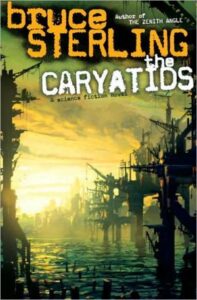
BOOK REVIEW | The Caryatids by Bruce Sterling Thumbnail

The Caryatids is the latest novel by Bruce Sterling, one of the founders of cyberpunk. True to his style, every page explodes with new ideas on technology, and its social and political effects.

One of the central themes of the book is catastrophic climate change. This is surely controversial among libertarians, but what is interesting from a libertarian perspective is how this idea is handled. Traditional nation-states, with the lone exception of China, collapsed during the climate crisis. In their place, two “global civil societies” emerged: the Dispensation, a flashy entrepreneurial capitalist society, and the Acquis, a global collective that is focused on rebuilding Earth's shattered ecosystems. The relationship between the two is very complex; war is generally held to be obsolete, replaced by constant economic competition and espionage. However, both groups also cooperate on a number of projects. The state of China remains, although at the expense of millions of its own citizens. All three groups fully embrace high technology to try to rebuild the world, each in their own way.

[continue reading…]

Help Promote Prometheus Unbound by Sharing this Post

Help Promote Prometheus Unbound by Sharing this Post

In a new addition to the Mises Institute's online media library today, part of The Libertarian Tradition podcast series, Jeff Riggenbach discusses libertarian science fiction.

Riggenbach discusses the role of science fiction in keeping individualism alive, the phenomenon of all the best known libertarian novels being science fiction novels, Eric S. Raymond's “A Political History of SF” in which Raymond argues that science fiction has a natural affinity with libertarianism, and the importance of dramatizing our values (pdf).

Reviewed in some detail are A.E. van Vogt's novel The Weapon Shops of Isher and Eric Frank Russell's novel The Great Explosion.

Transcript.

Help Promote Prometheus Unbound by Sharing this Post