In a recent addition to The Libertarian Tradition podcast series, part of the Mises Institute's online media library, Jeff Riggenbach discusses Friedrich Hayek and American Science Fiction.
You can also read the transcript, which was later published as a Mises Daily article.
In the podcast, Riggenbach discusses the dramatization of Austrian economist Friedrich Hayek's ideas in William Gibson's novel Pattern Recognition and Alfred Bester's short story “Time is the Traitor.”
Podcast: Play in new window | Download
Help Promote Prometheus Unbound by Sharing this Post
When I wasn't paying attention Jeff Riggenbach did two more audio podcasts on libertarianism and science fiction in his series for the Mises Institute, The Libertarian Tradition. Here is one, a followup on the previous podcast on libertarian science fiction.
You can also read the transcript, which was later published as a Mises Daily article: “Some Further Notes on Libertarian Science Fiction.”
In the podcast, Riggenbach discusses Anthony Burgess's novel A Clockwork Orange and several novels by Philip K. Dick (including The Man in the High Castle, which our own Matthew Alexander recently reviewed) as well as two nonfiction books.
Podcast: Play in new window | Download
Help Promote Prometheus Unbound by Sharing this Post

Author Philip K. Dick

It seems to me that of the two most important elements of a story, plot and character, plot seems to be more masculine and character more feminine. That is to say, a story for men, if it skimps on either of the two, is more likely to skimp on character, while a story for women will shortchange the plot. The best stories, of course, are strong in both categories. Science fiction, being a more masculine genre — in fact the only genre of fiction whose readership is more male than female — has traditionally been solid on plot and hit or miss with the characters. There are exceptions, as one would expect, and Philip K. Dick's The Man in the High Castle, a Hugo Award winner, is one of these.
The story takes place in what was the present day when the novel was written, 1962, but in an alternate timeline where Nazi Germany and Imperial Japan won World War II. The United States has been carved into puppet governments; Germany has sent astronauts to Mars, drained the Mediterranean for farmland and committed multiple genocides; Japan controls the west coast of North America, having become a cultural as well as political hegemon.
It is a marvelous setting, both in conception and in description. Dick's prose makes it come alive with a few deft touches here and there, sparse but effective. Whereas in most stories the setting serves as a place for the plot to take place, the reader here gets the sense that the plot is just something to have happen in the setting. The world and its characters are the point; what they do in the narrative has less importance.
[continue reading…]
Help Promote Prometheus Unbound by Sharing this Post
If you enjoy dystopian fiction, and dystopias often provide great fodder for libertarians, be sure to keep an eye on Tor.com this week.
From the announcement:
“It was a bright cold day in April, and the clocks were striking thirteen.” —Nineteen Eighty-Four
Over sixty years later, 1984 has come and gone, but Orwell's unsettling vision of the future continues to resonate throughout our culture, along with so many other great dystopian works of the last century, from Fahrenheit 451 toThe Hunger Games, Metropolis to Blade Runner, Harrison Bergeron to The Handmaid's Tale…the list goes on and on and so, on this bright, not-so-cold day in April, we're pleased to announce a weeklong celebration of a subgenre which has continually challenged the comfortable boundaries of our imaginations.
[continue reading…]
Help Promote Prometheus Unbound by Sharing this Post
Finalists for the 2011 Prometheus Award for best libertarian novel were announced just yesterday. One finalist, Ceres, by past award-winner L. Neil Smith, has already been reviewed on Prometheus Unbound. Also making the cut is Cory Doctorow's For The Win. I have a copy of this novel and plan to review it soon, after I publish a few overdue reviews.
As a reminder to our readers, we are open to submissions of reviews (as well as news, articles, interviews). Even if you can't contribute regularly, we'd like to have a number of part-timers on our staff who only contribute occasionally. We're even open to one-time contributors.
So if you'd like to read and review one of the other Prometheus Award finalists, nominees, past winners, or another piece of fiction, we'd be happy to consider it for publication.
Below is the full press release from the Libertarian Futurist Society, which presents the Prometheus Award:
[continue reading…]
Help Promote Prometheus Unbound by Sharing this Post
- From io9 comes this story of a supermodel brainwashed to work for the CIA:
In the movie Salt, Angelina Jolie plays a double-agent who is mind-controlled by scary remnants of the USSR secret service. And in real life, the 1940s bombshell Candy Jones was apparently brainwashed with drugs and used as a CIA covert operative. At least, according to testimony that Jones gave while under hypnosis, after her husband realized that she was acting strangely and seemed to have a split personality. Several years ago, the Fortean Times described what Jones reported while hypnotized: More »
- To critics of Ayn Rand's Atlas Shrugged who sneeringly intone that her plot and villains are unrealistic, John Stossel observes:
Joe Biden Railroad
It's amazing how modern politics resembles scenes of Ayn Rand's best-seller Atlas Shrugged.
Like the one in which a high-ranking government official pumps millions of dollars into a failing railroad company. The grateful railroad CEO rewards the government official by renovating his hometown train station and naming it after the government official. The renovation costs $5,700,000 more than expected.
Then comes the ribbon cutting ceremony. The CEO gets on one of his trains to go to the ceremony, but it breaks down. No surprise there: One out of every four trains his company runs is late [pdf]. The CEO, chuckling at the irony, abandons the train and takes a car to the ceremony.
Unfortunately, that wasn't a scene in Atlas Shrugged. It happened this weekend.
The government official is Joe Biden.
By the way, the first of three Atlas Shrugged movies opens next month, appropriately on April 15th.

Do you know of any other examples?
Help Promote Prometheus Unbound by Sharing this Post
Good things come to those who wait, the old adage goes, and the world has waited a century for Mark Twain's autobiography, which, in Twain's words, is a “complete and purposed jumble.” But this 760 page jumble is a good thing. And well worth the wait.
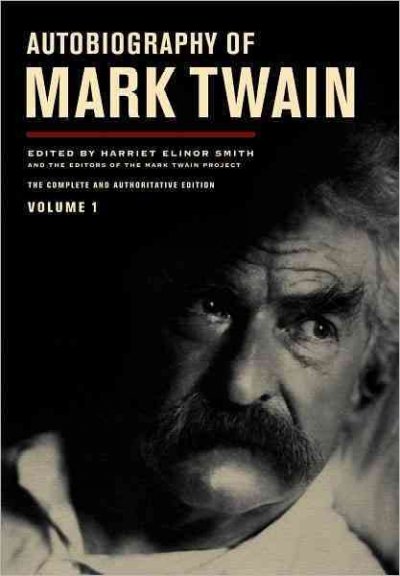 Twain, or Samuel L. Clemens, compiled this autobiography over the course of 35 years. The manuscript began in fits and starts. Twain, while establishing his legacy as a beloved humorist and man of letters, dashed off brief episodes here and there, assigning chapter numbers to some and simply shelving others. In 1906, he began making efforts to turn these cobbled-together passages into a coherent narrative. He even met daily with a stenographer to dictate various reflections and then to compile them into a single, albeit muddled, document. The result was a 5,000 page, unedited stack of papers that, per Twain's strict handwritten instructions, could not be published until 100 years after his death.
To say that we've waited a century to view this manuscript is only partially accurate because pieces of the manuscript appeared in 1924, 1940, and 1959. But this edition, handsomely bound by the University of California Press, and edited by Harriet Elinor Smith and others of the Mark Twain Project, is the first full compilation of the autobiographical dictations and extracts to reach print. The editors, noting that “the goal of the present edition [is] to publish the complete text as nearly as possible in the way Mark Twain intended it to be published before his death,” explain that “no text of the Autobiography so far published is even remotely complete, much less completely authorial.” The contents of this much-awaited beast of a book, then, are virtually priceless, and no doubt many of the previously unread or unconsidered Twain passages will become part of the American canon.
Stark photographs of the manuscript drafts and of Twain and his subjects — including family members and residences — accompany this fragmentary work. The lively and at times comical prose is in keeping with the rambling style of this rambling man whom readers have come to know and appreciate for generations. Would we have expected any less?
[continue reading…]
Help Promote Prometheus Unbound by Sharing this Post


