- From Mike P. over at The Emptiness comes “Socialism: A love story — Star Trek,” in which he discusses his love affair with Star Trek and how realizing it's a utopian socialist fantasy actually makes the show more enjoyable.
- From SF Signal comes news that the Hugo Award–winning Encyclopedia of Science Fiction, edited by John Clute and Peter Nicholls, is receiving a long-awaited update to its third edition (the last, second, edition was published in 1993) and — wait for it — is being made available for free online. Why? Oh, I don't know, maybe reading through the encyclopedia will tempt people into buying more books and ebooks of and about the stories and authors described within it. And simply keeping the history of the genre alive and readily accessible to future generations is a worthy endeavor in itself, of course.
From the press release:The third edition of the Encyclopedia of Science Fiction, the definitive reference work in the field, will be released online later this year by the newly-formed ESF, Ltd, in association with Victor Gollancz, the SF & Fantasy imprint of the Orion Publishing Group, whose support will enable the text to be available free to all users. This initial “beta” version, containing about three-quarters of the total projected content, will be unveiled in conjunction with Gollancz's celebrations of its 50th anniversary as a science fiction publisher.
[continue reading…]
Prose
NEWS ROUNDUP | Trek Socialism, SF Encyclopedia Online, Innovations in Publishing
in News, Prose, Science Fiction, Technology, TV
Help Promote Prometheus Unbound by Sharing this Post

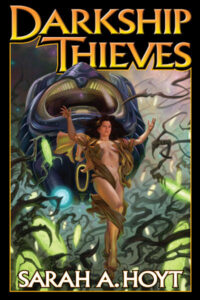
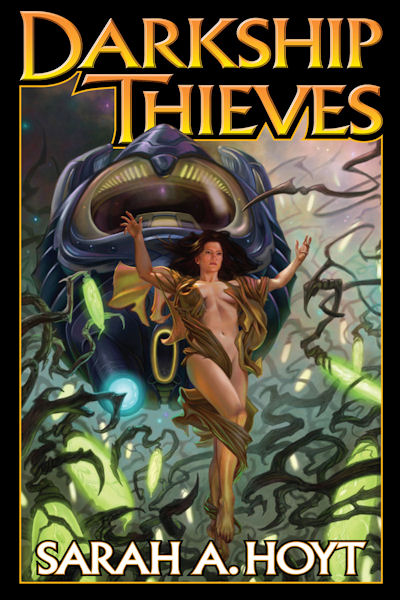 The Libertarian Futurist Society has announced this year's winners of their Best Novel and Hall of Fame awards.
- Best Libertarian Novel Winner: Darkship Thieves by Sarah Hoyt (Baen).
- Hall of Fame Winner: Animal Farm by George Orwell.
Alas, I didn't get around to reading and reviewing Cory Doctorow's For the Win in time for the voting, but I still plan on doing so. Matthew Alexander reviewed another of the finalists, L. Neil Smith's Ceres.
Here's the official press release:
The Libertarian Futurist Society will hold its annual awards ceremony for the Prometheus Award during Renovation, the 69th World Science Fiction Convention, to be held Aug. 17-21 in Reno, Nevada. The specific time and location will be available in the convention program.
The winner of the Best Novel award is Darkship Thieves, by Sarah Hoyt (Baen Books). The Hall of Fame award was won by Animal Farm, a short novel written by George Orwell in 1945. Sarah Hoyt will receive a plaque and a one-ounce gold coin, while a smaller gold coin and a plaque will be presented to Orwell's estate.
Darkship Thieves features an exciting, coming-of-age saga in which a heroic woman fights for her freedom and identity against a tyrannical Earth. Hoyt's novel, dedicated to Robert A. Heinlein, depicts a plausible anarchist society among the asteroids. Hoyt is a prolific writer of novels and short fiction, though this is her first time as Prometheus finalist.
Help Promote Prometheus Unbound by Sharing this Post

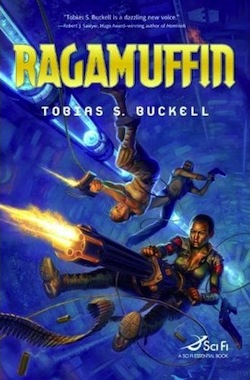 As I mentioned in my review of Crystal Rain, I enjoyed reading Tobias Buckell's debut novel, but I enjoyed reading the sequel, Ragamuffin (Tor, 2008), even more. This may be because Buckell has grown as a writer or it may be because Ragamuffin is more a traditional galaxy-spanning space opera, one of my favorite subgenres. But another reason is that there are more prominent libertarian themes in Ragamuffin than there were in Crystal Rain, enough that it was a finalist for the 2008 Prometheus Award.
Where Crystal Rain was set on a lost colony planet mostly devoid of advanced technology, Ragamuffin opens on an advanced planet ruled by an alien race called the Gahe, who are themselves a client race under the rule of the secretive Satraps. Human beings are officially “free” in the “benevolent” Satrapy, but in fact are forced to live on the margins of society — on space stations in the middle of nowhere, on interdicted planets cut off from the rest of the galaxy by collapsed wormholes (including Earth itself), or on reservations. On the Gahe planet, Astragalai, humans who don't want to serve in the role of intelligent pet for a Gahe master must live on a reservation, which they can only leave when granted a temperary “human safety” pass. Woe to the human who does not return to his reservation before his temporary pass expires: the penalty is death or enslavement.
We are first introduced to the protagonist of the novel, Nashara, on one such reservation called Pitt's Cross. Fans of Pepper and John from Crystal Rain will be increasingly disappointed not to see them at the outset, so I think it is best to go into this novel with the foreknowledge that characters from Crystal Rain do not make an appearance until about halfway through. Still, Nashara does quickly grow on you and you will get to see Pepper open a big ol' can o' whoop ass eventually, so hang in there. And if it's Pepper-style whoop ass you're after, Nashara will not disappoint.
So, anyway, Nashara escapes Pitt's Cross and rides on an orbital skyhook and transport pod up to a space station to meet up with a group, the revolutionary League of Human Affairs, for whom she had just completed a dangerous job. The League wants to overthrow the Satrapy and achieve real freedom for humanity. But Nashara's loyalties lie elsewhere and she has a greater mission to accomplish. Things don't go as planned, but Nashara manages to hitch a ride on a spaceship and proceeds to be hunted in a race across the galaxy by agents of the Satrapy.
Help Promote Prometheus Unbound by Sharing this Post

NEWS ROUNDUP | Douglas Adams vs. Ayn Rand, Digital Publishing, Tablets & Ereaders
in IP, News, Prose, Science Fiction, Technology
- Brian Defferding (?) over at Practical Praxeology tells us “Why The Hitchhiker's Guide to the Galaxy is Better Atheist Libertarian Literature than Any Ayn Rand Book.” Do you agree?
- Digital publishing, tablets, ereaders, and the changing genre publishing landscape:
- Wired – Epicenter: “Digital Book Publishing Models to the Rescue.” A few of the interesting business models that are emerging, including J.K. Rowling's for the ebooks of the Potter series.
- Wired – Epicenter: “Are Tablets Killing E-Readers? Um, No….”
- Adventures in Scifi Publishing podcast #124: Fascinating interview with multi-genre author Kristine Kathryn Rusch about how digital publishing is changing the genre publishing landscape and stirring up controversy: outdated accounting practices, publisher undercounting of ebook sales, shady new agent practices (including one mentioned in the first Wired article above) and whether you even need or should get an agent now, publishing and agent contracts, foreign rights, ebook rights, IP lawyers, and so on. If this podcast episode piques your interest, be sure to check out Kris's Business Rusch series of blogposts for more on these topics.
Help Promote Prometheus Unbound by Sharing this Post

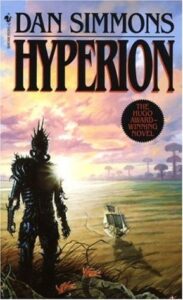
I found Hyperion to be the kind of book I hope every book will be when I first crack it open. This came as a mild surprise, given that it is modeled after The Canterbury Tales, in which a group of pilgrims take turns telling their stories of how they came to the pilgrimage. It is not a structure that thrills me, but the book is so well written, the world so well-conceived, and the stakes so unique and important that I found myself agreeing with the general critical acclaim that has been heaped upon it through the years. It is unquestionably one of the best scifi novels I have ever read.
In the world of the story, Earth has long since been destroyed and humans have colonized much of the galaxy. Most worlds are connected by worm holes, though a few exist outside this system; one such world is Hyperion. On Hyperion lives the Shrike, a mysterious creature that lives to kill. It is customary for some to make a pilgrimage to where the Shrike wanders, and when the Shrike finds a group of pilgrims it kills all but one member who may then petition it. This custom, at the time of the story, has almost been abandoned, but a group is put together for one last pilgrimage as a hoard of Ousters — nomadic humans who have taken to living in zero gravity and evolved into a different species — nears the planet and prepares to attack.
The setting for the story is richly imagined, on a level with Dune, Middle Earth and other such classics. The tales of the various pilgrims take us to many different worlds, and each becomes, as it is presented to us, distinct through the grand conception and the fine details. The planet of Hyperion is especially well conceived, with enough variety, plausibility, history and ingenuity to make us wonder if it might not actually exist somewhere. It holds the Time Tombs, grand and enigmatic structures that are moving backwards in time. There is a sea of tall grass that resembles a proper sea from afar, but none may cross it on foot because of the serpents that inhabit it. There is the abandoned Poets' City, whose inhabitants were slaughtered by the Shrike. The other worlds are also differentiated. That old cliché in scifi in which each planet has one defining characteristic — and probably one culture, one language, one government — has given way to something more realistic in recent decades, and Hyperion is a prime example of this welcome trend.
Help Promote Prometheus Unbound by Sharing this Post

THE LIBERTARIAN TRADITION PODCAST | C.M. Kornbluth and The Syndic
in Featured Posts, Novels, Reviews, The Libertarian Tradition Podcast
Podcast: Play in new window | Download
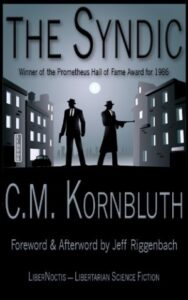
Get it for free in epub and mobi formats!
In a recent addition to The Libertarian Tradition podcast series, part of the Mises Institute's online media library, Jeff Riggenbach discusses the brief life of C.M. Kornbluth (1923–1958) and his novel The Syndic.
You can also read the transcript below:
The late Samuel Edward Konkin III was a firm believer in the power of science fiction to spread the libertarian message. He himself had been converted to libertarianism partly by reading the works of Robert A. Heinlein, and Heinlein remained his favorite science fiction writer for the rest of his life. Every July for years, he threw a joint birthday party for himself and Robert A. Heinlein (Sam's birthday was July 8; Heinlein's was July 7). The last and largest issue of his magazine,New Libertarian, was devoted to Heinlein, as was a sort of mini-conference he held, also in the late 1980s, under the auspices of his Agorist Institute. This mini-conference featured presentations by Sam, J. Neil Schulman, and yours truly, along with much spirited discussion.
But if the works of Robert A. Heinlein topped Sam's list of great libertarian science fiction, they were far from the only titles on that list. He was also a great admirer of Eric Frank Russell's Great Explosion, for example. He expressed enthusiasm for A.E. van Vogt's fiction, especially The Weapon Shops of Isher. And, he told me more than once in conversation, he held C.M. Kornbluth's 1953 novel, The Syndic, in high esteem and considered it lamentably little known and much underappreciated among libertarian science fiction novels. I suspect part of the reason Sam never wrote about The Syndic was that he felt any public display of approval on his part for a writer like C.M. Kornbluth would require at least a bit of explanation. You see, Kornbluth was a Futurian, and libertarian science-fiction fans back in Sam's heyday — the 1970s and '80s — were almost always critical of the Futurians, if not openly hostile to them.
Libertarian science fiction fans of today care a good deal less for such ancient controversies, I suspect. Libertarian science-fiction fans under 40 are probably at least a little unclear on just who or what the Futurians were. Those old timers like me who know who they were have now lived long enough that we wonder whether it really matters who they were — whether it mattered even at the time.
Podcast: Play in new window | Download
Help Promote Prometheus Unbound by Sharing this Post

SHORT FICTION REVIEW | “The Calorie Man” by Paolo Bacigalupi
in Featured Posts, IP, Reviews, Science Fiction, Short Fiction
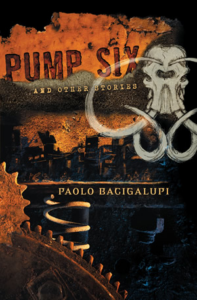
I've read a number of Paolo Bacigalupi's short fiction stories and, though I am skeptical of his environmentalism and don't agree with (what I can glean of) his politics, they have all been uniformly well-written and compelling — interesting worldbuilding coupled with fine prose and characterization. They all seem to be set in a post–global warming/post–energy crisis future Earth, maybe a century or so hence. “The Calorie Man” is no exception. There's even a libertarian angle that I'll get to in a moment.
Paolo Bacigalupi is being nominated for, and winning, awards left and right. “The Calorie Man,” actually a novelette, was nominated for the Hugo Award and won the Theodore Sturgeon Award in 2006. First published in the October/November 2005 double issue of The Magazine of Fantasy & Science Fiction, this story can also be found in The Year's Best Science Fiction: Twenty-Third Annual Collection, edited by Gardner Dozois — where I first encountered it — and in Bacigalupi's short fiction collection, Pump Six and Other Stories, itself a winner of the Locus Award for Best Collection in 2009 and containing a number of award nominee and winning stories.
Our petroleum-based and prosperous time, referred to in “The Calorie Man” as the Expansion, gave way to an energy Contraction and one gets the impression that humanity has struggled slowly to adapt. This future earth is more advanced in some ways (e.g., genetic engineering) and less advanced in others, mainly owing to the lack of cheap and powerful fuel (e.g., people are reduced to methane lamps for lighting and powering computers with human labor via treadles). There are trappings of steampunk — dirigibles are mentioned, and high-precision kink-springs are the primary means of storing kinetic energy and powering engines — but the tone is decidedly not that of steampunk. I thought to call Bacigalupi's style of science fiction biopunk but alas someone else has already coined that term for it; enviropunk would also be a good label.
The plot of the story centers around greedy megacorporations and the genetically engineered and patented crops that are used to feed and fuel human beings, their genetically engineered beasts of burden, and their machines. We're not talking your run-of-the-mill biofuel, such as ethanol, here. No, Bacigalupi's twist is to have the crops used to feed mulies and megadonts (genetically engineered descendants of mules and elephants, respectively, I think) that transform those calories into stored kinetic energy by walking treadmills that wind the aforementioned high-precision kink-springs. All “natural,” unpatented crops have been conveniently wiped out by agricultural disasters and diseases to which the genetically engineered crops turned out to be resistant or immune, leaving a few agricultural corporations in tightfisted, monopolistic control of the world's primary sources of food and energy.
As “The Calorie Man” opens, we're introduced to the main character — an Indian transplant to the American South. Lalji plies the Mississippi River in a kink-spring-powered boat looking for antiques from the Expansion to salvage and sell. But an old friend has an unusual and dangerous job for him now. He is to travel far up north to find and smuggle back to New Orleans a man the big agricultural corporations want captured or killed, a man who supposedly can upend the economic status quo.
Help Promote Prometheus Unbound by Sharing this Post


